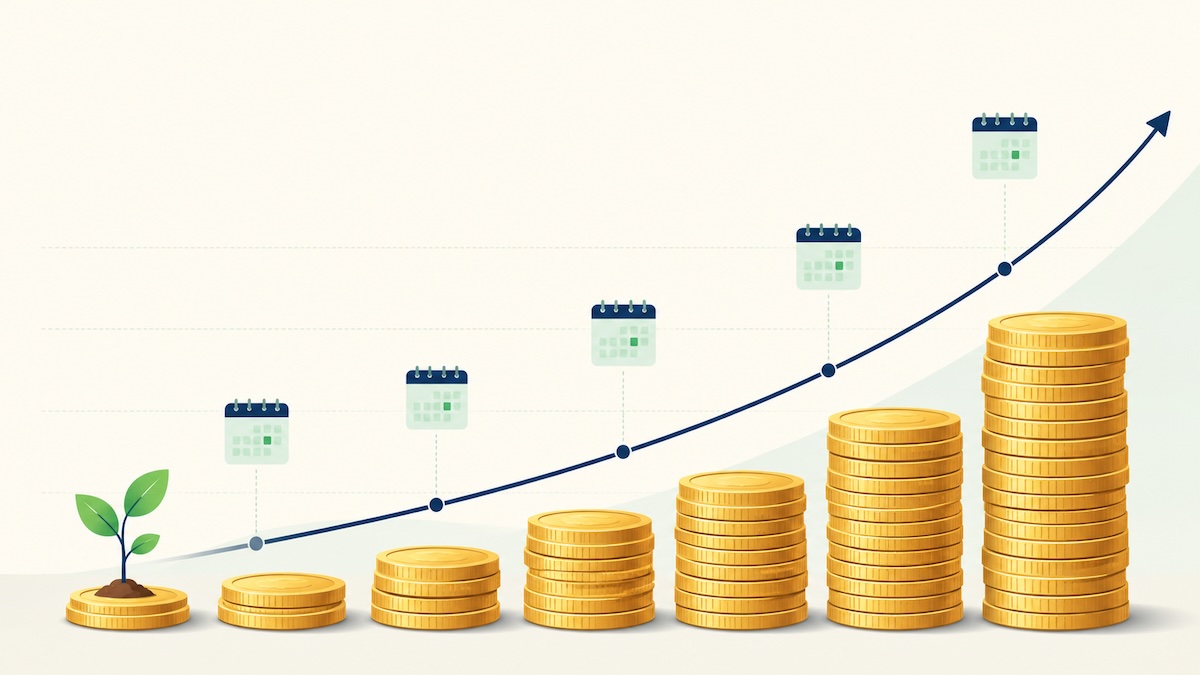
A single dollar invested at 7% for 40 years becomes $14.97 with compound interest — but only $3.80 with simple interest. The difference is interest earning interest, and over multi-decade horizons it transforms ordinary contributions into life-changing balances. Understanding the math behind compound interest, the role of compounding frequency, and how monthly deposits change the trajectory is the single most useful financial skill for anyone planning retirement, saving for a house, or building long-term wealth.
What Compound Interest Actually Means
Compound interest is interest calculated on both your initial principal and the accumulated interest from previous periods. With simple interest, $10,000 at 7% earns $700 every single year — $28,000 total over 40 years. With compound interest, the $700 earned in year one is added to the principal so year two earns interest on $10,700, year three on $11,449, and so on. After 40 years, that same $10,000 grows to $149,745 — over five times more than simple interest produces.
The exponential nature of compound growth is why it’s called the “eighth wonder of the world” in a quote frequently attributed to Albert Einstein. The math doesn’t care about your motivation or willpower — it just rewards time. A 25-year-old who invests $300 per month until age 65 at 7% accumulates roughly $786,000. A 35-year-old who invests the same $300 monthly until 65 accumulates only $352,000 — less than half, despite contributing only one-third less money. Those lost ten years can never be recovered.
The Compound Interest Formula, Explained
The fundamental compound interest formula is:
A = P × (1 + r/n)nt
Where A is the final amount, P is the starting principal, r is the annual interest rate as a decimal, n is the number of compounding periods per year, and t is the time in years. A $10,000 deposit at 7% annual rate compounded monthly for 20 years works out to: A = 10000 × (1 + 0.07/12)240 = 10000 × 4.0387 = $40,387.
When you also make regular monthly contributions, the formula expands to add the future value of an annuity component:
A = P(1 + r/n)nt + PMT × [((1 + r/n)nt − 1) / (r/n)]
PMT is your regular contribution amount. This is the formula every realistic compound interest calculator uses internally. Manual computation is tedious for long time horizons — our compound interest calculator handles the math instantly and shows the year-by-year breakdown so you can see exactly when growth accelerates.
Why Compounding Frequency Matters Less Than You Think
Banks love advertising “daily compounding” on savings accounts as though it’s a meaningful selling point. The math says otherwise. On $10,000 at 5% for 10 years, the final balance is:
- Annual compounding: $16,288.95
- Monthly compounding: $16,470.09 (+$181)
- Daily compounding: $16,486.65 (+$197 total)
- Continuous compounding: $16,487.21 (+$198 total)
Moving from annual to daily compounding adds just 1.2% to your final balance after 10 years. The leap from daily to continuous compounding adds less than $1 on a $10,000 starting balance. The effective annual rate (EAR) captures this: 5% nominal compounded daily has an EAR of 5.127%, while 5% nominal compounded continuously has an EAR of 5.127% — effectively identical.
What actually matters is the rate and the time horizon, not the compounding frequency. A 6% account compounded annually beats a 5% account compounded daily by a wide margin. When comparing savings products, always compare APY (annual percentage yield), which already accounts for compounding frequency, rather than the headline rate.
The Rule of 72: Mental Math for Doubling Time
The Rule of 72 is a shortcut for estimating how long it takes your money to double at a given annual rate. Divide 72 by the interest rate (in percent) to get the doubling period in years:
- At 3%: 72 / 3 = 24 years to double
- At 6%: 72 / 6 = 12 years to double
- At 8%: 72 / 8 = 9 years to double
- At 10%: 72 / 10 = 7.2 years to double
- At 12%: 72 / 12 = 6 years to double
The rule is an approximation derived from the natural logarithm of 2 — exact for any rate is t = ln(2) / ln(1 + r) ≈ 0.693 / r. The 72 approximation is accurate within 0.5 years for rates between 4% and 12%, which covers most realistic investment scenarios. For rates near 8% the Rule of 72 is almost exact; for rates below 4% or above 12%, use the rule of 70 or the rule of 69.3 for slightly better accuracy.
The Rule of 72 is the fastest way to compare investment opportunities mentally. A high-yield savings account at 4.5% doubles your money in 16 years. A diversified index fund averaging 9% doubles it in 8. The 401(k) match your employer offers — typically 50–100% on the first 3–6% of contributions — represents an instant 50–100% return, which the Rule of 72 reveals as “infinite doubling speed” on the matched portion.
Monthly Deposits: Where Real Wealth Comes From
Most people overestimate the importance of starting principal and underestimate the importance of monthly contributions. Consider three scenarios over 30 years at 7% annual return:
- $50,000 lump sum, no contributions: grows to $380,613
- $0 lump sum, $500/month contributions: grows to $611,729
- $10,000 lump sum + $500/month contributions: grows to $688,852
Regular monthly contributions of $500 over 30 years total only $180,000 in money in, yet the ending balance exceeds $600,000 — over three times the contribution amount. That extra $431,729 is purely accumulated interest on contributions made progressively over time. The earliest contributions compound the longest and contribute the most to the ending balance, which is why the conventional advice “start early” is mathematically grounded, not just a feel-good slogan.
When you model this with a real compound interest calculator, the year-by-year breakdown reveals an interesting pattern: in the first 10 years, your balance is dominated by the contributions you’ve made. By year 20, contributions and interest are roughly equal. By year 30, interest dwarfs contributions and accounts for over 70% of the total balance. The crossover point — where each year’s interest exceeds your annual contributions — is a major psychological milestone in long-term investing.
Compound Interest in Real Accounts (401k, IRA, ISA, TFSA, Super)
Compound interest math is universal, but the accounts that shelter it from tax vary by country. Each tax-advantaged account multiplies the power of compounding by removing the annual tax drag on interest, dividends, and capital gains.
United States — 401(k) and IRA: 2024 contribution limits are $23,000 for 401(k) (plus $7,500 catch-up at age 50+) and $7,000 for IRA. Traditional accounts defer tax until withdrawal; Roth accounts pay tax now and never again. Employer 401(k) matches typically add 3–6% of salary — free money that compounds for decades. Use a 401(k) calculator to model the full effect of contributions plus match plus compound growth.
United Kingdom — ISA and SIPP: Stocks & Shares ISA allows £20,000 per tax year, fully tax-free on growth and withdrawals — the cleanest compounding environment available to UK residents. SIPP (Self-Invested Personal Pension) adds tax relief on contributions (20% basic, up to 45% additional rate) but defers tax to retirement.
Canada — TFSA and RRSP: TFSA contribution room accumulates each year (CA$7,000 in 2024) and grows entirely tax-free. RRSP contributions are tax-deductible and grow tax-deferred until withdrawal. Both benefit massively from long-horizon compounding.
Australia — Superannuation: Employers must contribute 11% of salary to super (rising to 12% by 2025). Concessional contributions are taxed at just 15% on the way in and 0–15% on growth — a strongly compounding-friendly structure. For wealth-building projections, pair the compound interest calculator with a dedicated retirement fund calculator that accounts for contribution caps and tax treatment.
Inflation: The Number That Makes Compounding Look Smaller
Nominal returns ignore inflation. Real returns account for it. A 7% nominal return in a 3% inflation environment is only a 3.88% real return — significant, but a third smaller than headline figures suggest. Use the Fisher equation: (1 + nominal) = (1 + real) × (1 + inflation), which solves to real = (1 + nominal)/(1 + inflation) − 1.
Over 30 years at 7% nominal return, $500/month compounds to $611,729 in future dollars. Adjusted for 3% inflation, that same balance has the purchasing power of roughly $251,000 in today’s dollars — still substantial, but very different from the nominal headline. Always run long-horizon projections in both nominal and inflation-adjusted terms before making major decisions, especially retirement planning where inflation operates for 30–50 years post-contribution. Our inflation calculator converts any nominal balance to today’s purchasing power.
5 Mistakes That Kill Long-Term Compounding
1. Starting Late
A 25-year-old contributing $300/month at 7% until age 65 accumulates $786,000. The same person starting at 35 accumulates only $352,000. A 10-year delay costs $434,000 — more than the total cumulative contributions of the late starter. There is no investment skill that recovers lost time.
2. Pausing Contributions in Down Markets
Bear markets are when fixed monthly contributions buy the most shares — the mechanism behind dollar-cost averaging. Investors who stopped contributing to retirement accounts in March 2020 or late 2008 missed buying at exactly the prices that produced the largest subsequent gains. Automatic contributions remove this temptation entirely.
3. Cashing Out 401(k)s When Changing Jobs
A $20,000 401(k) balance cashed out at age 30 costs the worker the early-withdrawal penalty plus income tax (~30–40% combined), netting only $12,000–$14,000 today. The opportunity cost is far worse: at 7% for 35 years, the same $20,000 would have grown to $213,000. Always roll over to an IRA or new employer plan when changing jobs.
4. Ignoring Fees
An 0.5% annual expense ratio difference doesn’t sound like much. Over 40 years on a $500/month contribution growing at 7%, choosing a 0.05% index fund vs a 0.55% actively managed fund changes the ending balance from $1.32M to $1.18M — a $140,000 cost from a half-percent fee difference, compounded for four decades.
5. Skipping the Employer Match
A 50% match on the first 6% of salary is a guaranteed 50% return on those dollars before any market growth. Refusing the match to “deal with retirement later” is the most expensive single mistake in personal finance. The Rule of 72 says nothing about infinite doubling speed because no normal investment provides it — only an employer match does.
How to Use a Compound Interest Calculator
Effective use of a compound interest calculator requires honest inputs and meaningful scenario testing. Start with realistic assumptions: 6–7% real return for diversified stock index funds, 2–3% for high-yield savings accounts, 3–4% for bond-heavy portfolios. Avoid the temptation to plug in 12% returns based on a single hot year — long-run averages dominate over decades, not single-year outliers.
Run three scenarios for any major planning question: conservative (lower rate, lower contribution), expected (your most likely path), and aspirational (higher rate, max contribution). The range between conservative and aspirational reveals how much your outcome depends on factors within your control (contribution rate, time horizon) versus those outside your control (market returns). For most savers, contribution rate matters more than rate of return over time horizons under 25 years; rate of return dominates beyond 30 years.
For specific goals, pair the compound interest calculator with the right specialty tool: an investment calculator for portfolio modeling, a savings calculator for shorter-term goal planning, or a retirement fund calculator for full retirement projections that account for inflation, Social Security, and withdrawal phases.
Conclusion: Time Is the Single Most Valuable Variable
Compound interest is mathematically simple but psychologically counterintuitive. Linear thinkers underestimate exponential growth, and human intuition treats “40 years from now” as too distant to act on today. The math is unforgiving on both counts: every year of delay carves a meaningful piece out of the final balance, and every year of disciplined contribution adds to it.
The single most useful action is to run your own numbers — not someone else’s example — through a realistic compound interest calculator. Plug in your actual income, contribution rate, time horizon, and realistic rate assumptions. The output is rarely what people expect, and the surprise (in either direction) is usually motivating enough to lock in better habits than any abstract advice can produce.