Why Tank Volume Matters
Whether you are filling a swimming pool, dosing an aquarium, ordering heating oil, or sizing a rainwater butt, the question is the same: how much will this tank hold? Tank volume is just the volume of a 3D shape — usually a cylinder or a box — converted into the capacity units you actually buy and bill in: gallons and litres. This guide shows the formulas, the conversions, and the traps that make tank math go wrong.
Volume vs Capacity: Cubic Units to Gallons and Liters
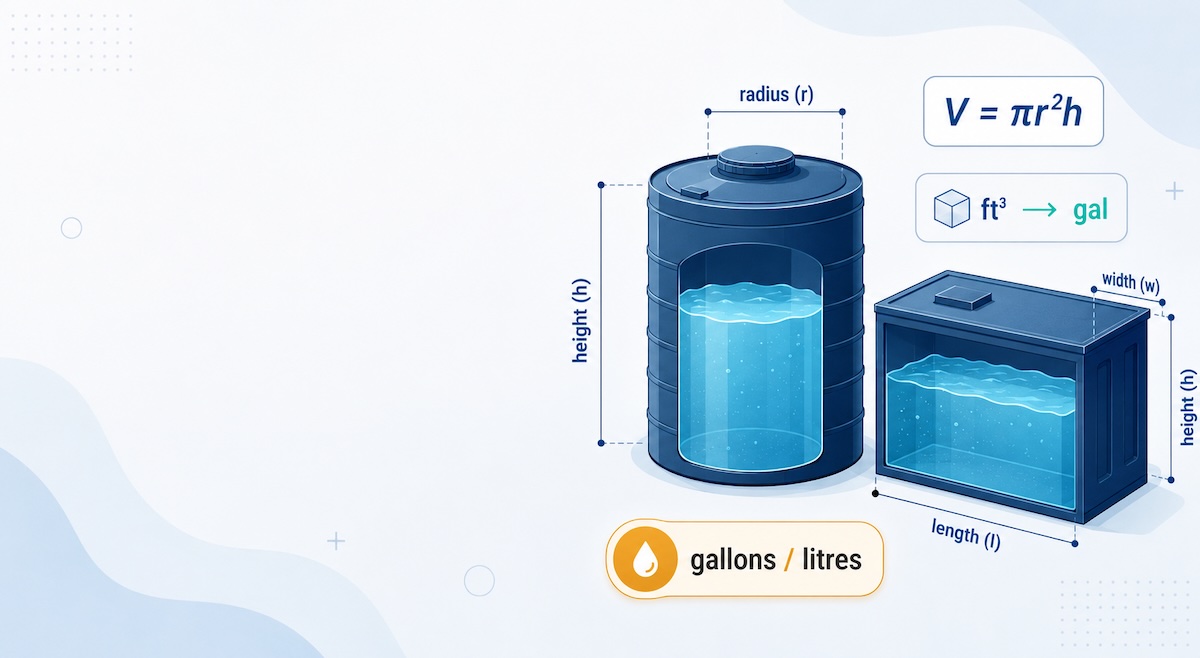
Volume is the space inside the tank, measured in cubic units (cm³, ft³, m³). Capacity is the same space expressed as liquid: litres or gallons. The bridge between them is a set of fixed conversions:
- 1 cubic foot = 7.481 US gallons = 28.32 litres
- 1 cubic metre = 1,000 litres = 264.2 US gallons
- 1 US gallon = 3.785 litres; 1 imperial gallon = 4.546 litres
So the workflow is always: compute the cubic volume from the tank's shape, then multiply by the right conversion factor.
How to Calculate the Volume of a Cylindrical Tank
A vertical cylindrical tank uses V = πr²h — the circular base area times the height. Measure the radius (half the diameter) and the height in the same unit.
Example: a tank 6 ft across and 5 ft tall
- Radius = 6 ÷ 2 = 3 ft
- Volume = π × 3² × 5 = 141.4 ft³
- Capacity = 141.4 × 7.481 ≈ 1,058 US gallons (≈ 4,004 litres)
How to Calculate the Volume of a Rectangular Tank
A rectangular (box) tank is the simplest: V = length × width × height. An aquarium 4 ft long, 1.5 ft wide, and 2 ft deep holds 4 × 1.5 × 2 = 12 ft³ × 7.481 ≈ 90 US gallons. Keep every measurement in the same unit, and measure the inside dimensions — wall thickness eats into real capacity.
Horizontal and Partially Full Tanks
A horizontal cylinder that is completely full still uses V = πr²h (length as the height). But a partially full horizontal tank is much harder — the cross-section is a circular segment, not a simple fraction of the circle. A tank filled to half its diameter is exactly 50% full, but a tank filled to one-quarter of its diameter is only about 19.6% full, not 25%. For partial horizontal tanks, use a calculator rather than a quick guess.
Pool and Aquarium Volume
A rectangular pool with a sloping floor uses the average depth: V = length × width × (shallow + deep) ÷ 2. A 30 × 15 ft pool sloping from 3 ft to 8 ft holds 30 × 15 × (3 + 8) ÷ 2 = 2,475 ft³ ≈ 18,513 gallons. For aquariums, the rule of thumb is that water weighs about 8.34 lb per US gallon — a 90-gallon tank adds roughly 750 lb, so check the floor as well as the volume.
Common Tank-Volume Mistakes
- Using diameter instead of radius in πr² (halve the diameter first)
- Mixing units — feet for one dimension, inches for another
- Assuming a partially full horizontal tank fills linearly with depth
- Forgetting to subtract wall thickness on thick-walled tanks
- Confusing US gallons (3.785 L) with imperial gallons (4.546 L)
The Quick Way
The formulas are simple, but the unit conversions are where errors creep in. Our free volume calculator handles cylinders, boxes, spheres, and cones, and converts the result to litres and gallons automatically. For the full set of 3D formulas behind it, see our guide to calculating the volume of 3D shapes.
Measure carefully, keep your units consistent, and let the conversions do the rest — and you will never over-order water, oil, or gravel again.