Introduction: A Magnitude-6 Earthquake Is Not 50% Worse Than a Magnitude-4
It is 100 times stronger. That gap between what the number looks like and what it means is the signature of a logarithmic scale, and once you start noticing it, you find it everywhere: in earthquakes, sound, acidity, starlight, music, and even in how your own senses work. Most guides to logarithms teach you how to compute them. This one is about something more useful for everyday understanding — why so much of reality is logarithmic in the first place, and how to read a world that compresses enormous ranges into small numbers.
What a Logarithmic Scale Actually Means
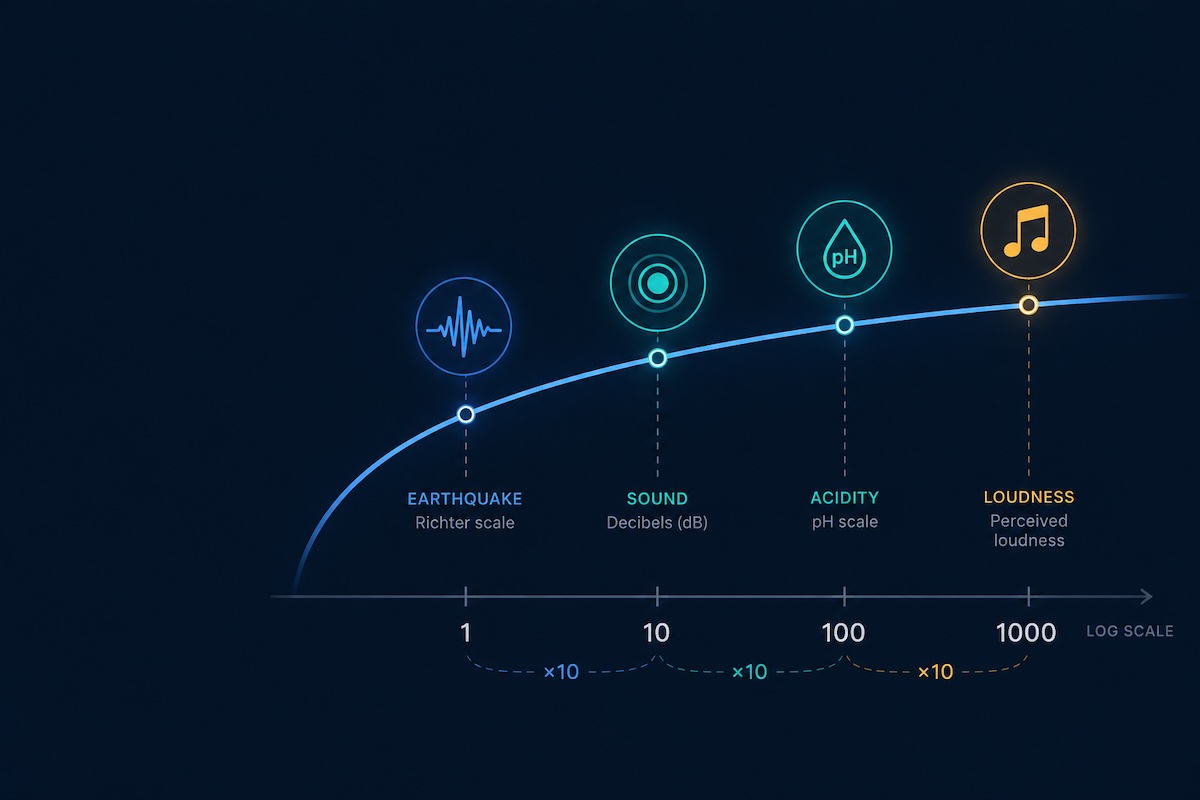
On a normal (linear) scale, each step adds a fixed amount: 1, 2, 3, 4. On a logarithmic scale, each step multiplies by a fixed amount: 1, 10, 100, 1000. The number you read is not the quantity itself — it is the exponent, the count of how many times you multiplied. That is exactly what a logarithm is: the power a base must be raised to in order to reach a value.
Why would nature and engineers bother? Because logarithmic scales tame quantities that span absurd ranges. The faintest sound you can hear and a jet engine differ by a factor of about a trillion. No linear chart can show both. Take the logarithm and that trillion-fold range collapses into a tidy 0–120 scale — the decibel.
Earthquakes: The Richter Scale
The Richter (and modern moment-magnitude) scale is base 10. Each whole-number step is a tenfold increase in measured wave amplitude — and, because energy grows faster than amplitude, roughly a 32-fold increase in released energy.
- Magnitude 5 → magnitude 6 = 10× the shaking, ~32× the energy
- Magnitude 5 → magnitude 7 = 100× the shaking, ~1000× the energy
This is why a "small-sounding" jump from 6 to 8 separates a damaging quake from a catastrophic one. The numbers look close; the reality is a thousandfold apart.
Sound: Decibels
Loudness is measured in decibels (dB), defined as 10 × log₁₀ of a power ratio. The rule of thumb that falls out of the math: every +10 dB is 10 times the power, and roughly a doubling of perceived loudness.
- A quiet library at 40 dB versus traffic at 80 dB is not "twice as loud" — it is 10,000 times the sound power
- This is why brief exposure to a 120 dB concert is dangerous while 60 dB conversation is not
Decibels exist precisely because human hearing itself spans such a vast range that only a logarithmic scale is practical.
Chemistry: The pH Scale
pH = −log₁₀[H⁺], the negative logarithm of hydrogen-ion concentration. So each pH unit is a tenfold change in acidity.
- Lemon juice at pH 2 is 100× more acidic than tomato juice at pH 4
- Pure water at pH 7 is 100,000× less acidic than that lemon juice
The compact 0–14 scale hides enormous multiplicative differences — again, the work of a logarithm.
Music: Octaves Are Logarithmic
Here is a logarithmic scale you can hear. Each octave doubles the frequency: the A above middle C is 440 Hz, the next A up is 880 Hz, the next 1760 Hz. Yet to your ear each step sounds like the same musical distance. Pitch perception is logarithmic — equal ratios feel like equal steps — which is why a piano keyboard is spaced the way it is.
The Deep Reason: Your Senses Are Logarithmic
Earthquakes and decibels are human inventions, but the pattern runs deeper. The Weber–Fechner law states that perceived intensity grows with the logarithm of the physical stimulus. Double the light, the sound, or the weight, and your senses register a fixed step, not a doubling. Your nervous system compresses reality logarithmically so that you can be sensitive to a whisper and still function next to a waterfall.
This is the unifying idea: logarithmic scales are not just a tidy charting trick. They mirror how perception, and much of the physical world, actually behaves — in ratios and multiples rather than in fixed additions.
Reading a Log Chart Without Being Fooled
When data spans many orders of magnitude — viral case counts, incomes, audio spectra — analysts plot it on a logarithmic axis, where equal spacing means equal ratios. The trap: a gentle-looking straight line on a log chart can represent ferocious exponential growth. Always check whether an axis is labeled 1, 10, 100, 1000 (logarithmic) rather than 1, 2, 3, 4 (linear) before judging how steep a trend really is.
From Reading Scales to Computing Them
Once the intuition clicks, the arithmetic is the easy part. To convert between a scale and the raw quantity behind it — how many times stronger one earthquake is than another, or what hydrogen-ion concentration a pH implies — you evaluate a logarithm. Our free logarithm calculator handles log base 10, natural log, log base 2, and any custom base, with the change-of-base formula and step-by-step working shown. To go deeper on the algebra, our walkthrough on solving logarithmic equations step by step picks up where this leaves off, while the basic laws of logarithms covers the product, quotient, and power rules.
For mixed problems that also involve powers, roots, and trig alongside logs, the scientific calculator keeps everything in one place.
Conclusion
A logarithmic scale is the world's way of fitting the very large and the very small onto a ruler you can actually read. Earthquakes, sound, acidity, brightness, and musical pitch all use one because the underlying quantities multiply rather than add — and your own senses do the same. The next time a number looks deceptively small, ask whether the scale is logarithmic. If it is, a one-point difference might quietly mean ten times, a hundred times, or a thousand times more.